
Woodward Shoutouts
Archives
Rediscovering Small-Town Charm: 2 Stoplights, 1 Soda Fountain
SIGN UP FOR OUR NEWSLETTER
When Main Street Had Two Stoplights and a Soda Fountain |
As told by J.T. Clevenger, former soda jerk, part-time philosopher, and full-time town gossip |
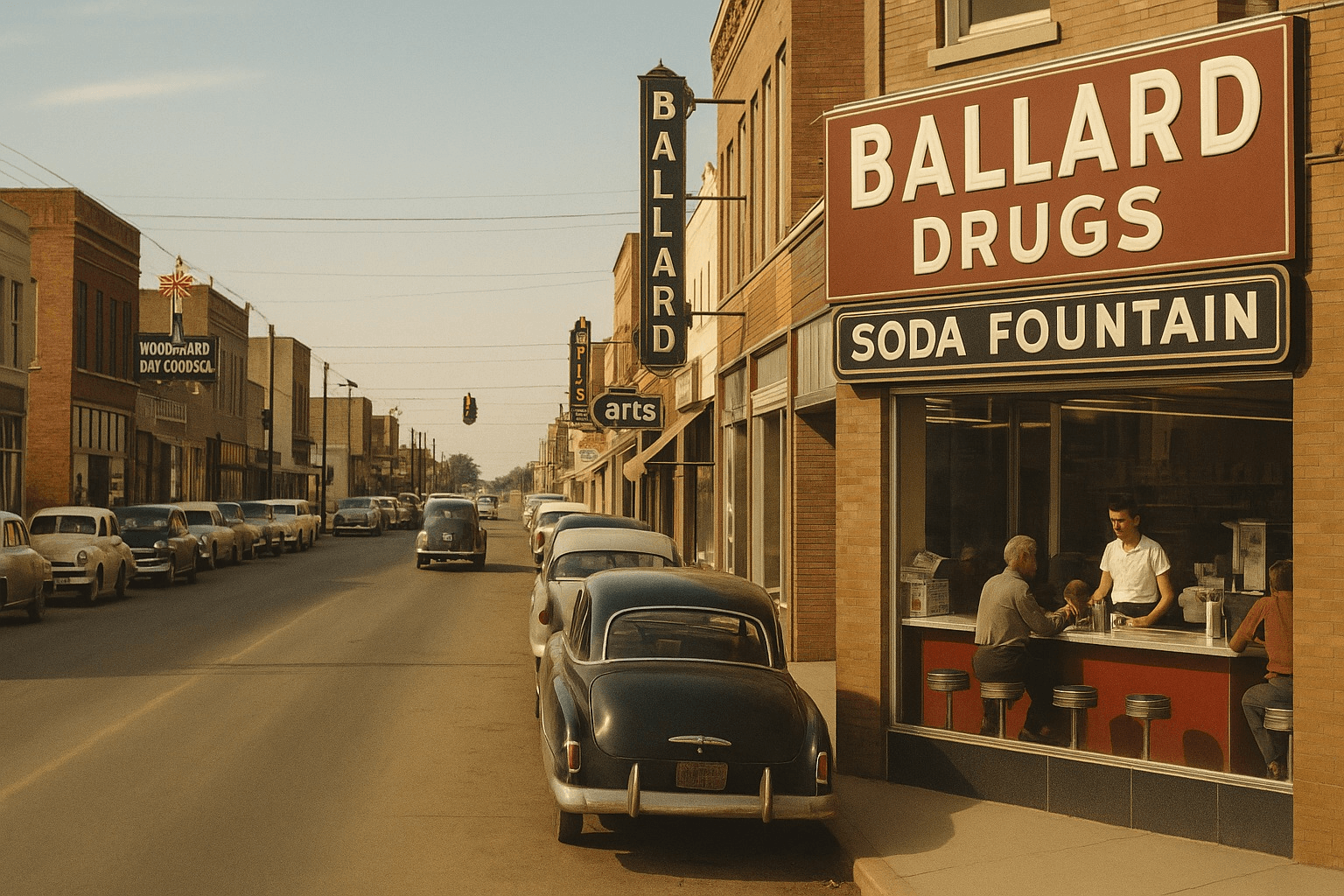 |
I was fourteen years old when I discovered the world ran on two things: root beer floats and small-town lies. And I should know — I served the first and told plenty of the second from behind the marble counter at Ballard’s Drugs, smack in the middle of Main Street between 8th and 9th, right where the sun hit just right on the front window every morning.
That soda fountain? It was the beating heart of Woodward, Oklahoma. A place where secrets cost a nickel, romance fizzed over like a poorly poured phosphate, and grown men debated wheat prices and baseball scores with the same red-faced intensity. And yes, Main Street really only had two stoplights — one just past the courthouse at 13th, and one that blinked like a lazy eye on 9th outside the Arts Theatre, closer to 8th.
Now don’t get me wrong — we had all the modern luxuries. A payphone. A jukebox that only played Patsy Cline and Elvis (whether you liked it or not). And a neon sign that buzzed like a mosquito trapped in a whiskey bottle. We were fancy by 1950s standards, which is to say we had indoor plumbing and three kinds of pie on Tuesdays.
But something happened that summer. Something that started with a stranger and ended with a memory so powerful I still taste it when I sip a Coke.
Chapter 1: The Stranger and the Storm
He walked in one afternoon, dusty boots and a hat pulled low, like he was auditioning for a Western no one asked him to star in. Ordered a cherry phosphate and didn’t say much except, “Storm’s coming.”
Which was ridiculous. The sky was bluer than a church lady’s dress on Easter Sunday.
“Sure, cowboy,” I said, handing him his drink. “And I suppose you got a magic weather stick in that satchel?”
He didn’t laugh. Just sipped slow and stared out the window toward Main, watching the people come and go — kids skipping past DeLuxe Cleaners, old man Jensen limping across the street toward the post office, and two high school sweethearts trying to look like they weren’t holding hands.
That’s when old Mrs. Tillingham burst in, breathless and pink like a boiled ham. “Did y’all hear? They’re tearin’ down the old post office!”
Gasps all around. Not because we cared about the post office — Lord knows it had the personality of a wet sock — but because it meant change was coming. And in Woodward, change was treated with the same suspicion we reserved for out-of-towners and non-baptized casseroles.
Chapter 2: The Night the Lights Went Out
That night, the wind rolled in like a freight train with a grudge. By dusk, the sky was the color of an old bruise, and both stoplights on Main swayed like drunkards at a barn dance.
The stranger? He was back. Said his name was Levi, used to live here before the 1947 tornado. Lost everything — his house, his folks, even his dog named Peanut. Came back to see what survived.
“Not much,” he said, tapping the counter. “But I figured this place would still be here.”
“Ballard’s? Shoot, this fountain will outlive cockroaches and Congress.”
He didn’t smile. Just stared as the power blinked and went out. The town froze. Everything but the wind.
In the flickering candlelight, Levi told us stories. Of the town before the storm. When Main Street had hitching posts, and dances on Saturday nights, and a sheriff who could shoot the whiskers off a cat at fifty paces (no one verified that). His voice painted memories so vivid I swore I could hear a phonograph crackle in the distance.
Chapter 3: Epiphany in a Root Beer Float
The next morning, the power was back, the stoplights blinked lazily, and Levi was gone. Left a note written on the back of an old soda menu:
Ballard’s closed five years later. Progress, they said. It’s a hardware store now, or maybe a vape shop — I try not to look. But every time I drive down Main from 13th to 5th, I remember that night. The stories. The storm. The magic.
The Big Lesson
Small towns are stitched together by stories and soda syrup. They hold tight to the folks who remember when the lights were fewer and the laughter louder. And even if the soda fountains fade, memory is a stubborn thing. It fizzes up when you least expect it.
So here’s your proverb, folks:
Editor’s Note: |